MosbyEllon Gibbs and the End of Distance
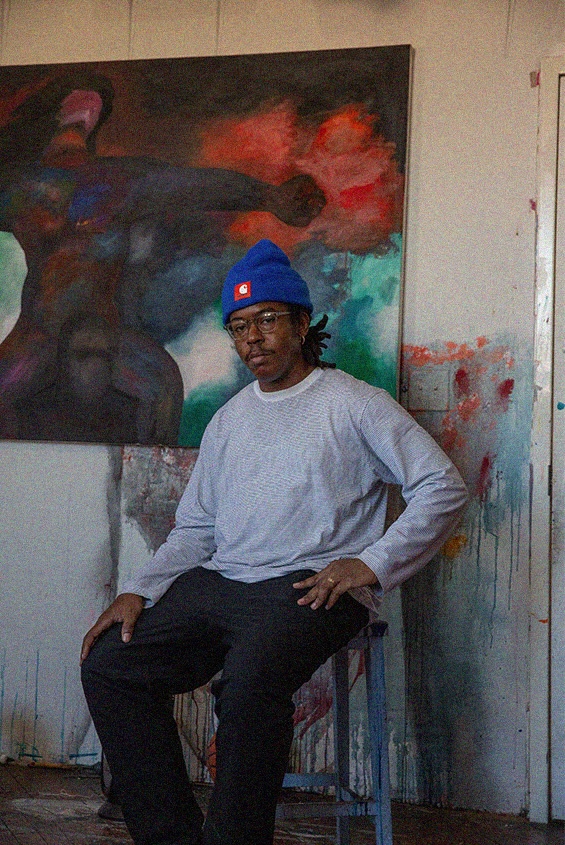
There is a moment in one of Ellon Gibbs’ paintings when a figure—half-shadow, half-animal—turns its head as if hearing something just outside the frame. Not quite fear. Not recognition. More like instinct. Around him, the world burns blue.
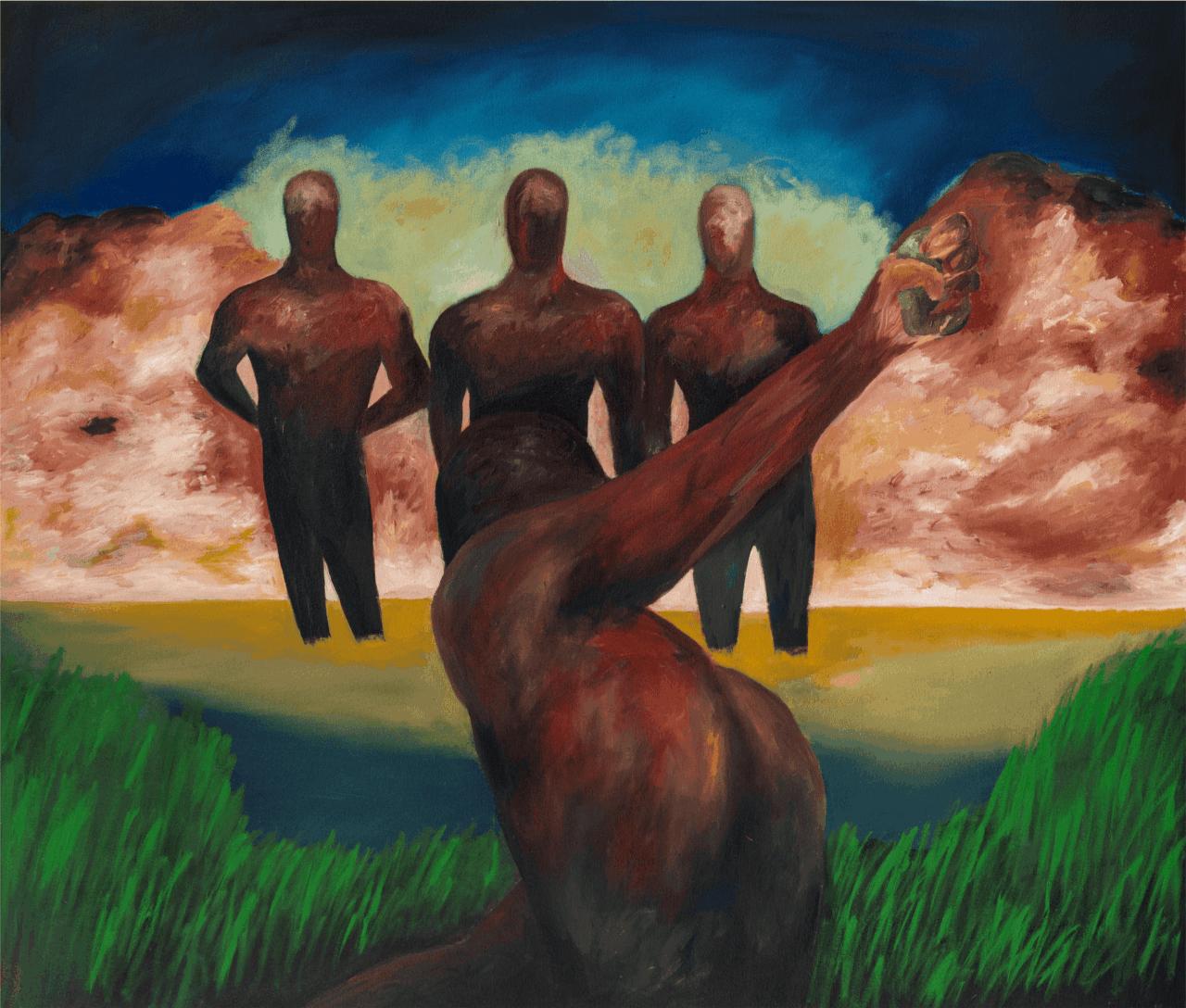
The Brooklyn-born painter has emerged as one of the more difficult artists to situate within the tidy frameworks of contemporary figurative painting. Critics have tried. Neo-primitivist. Afrofuturist. Ecological expressionist. Post-apocalyptic romantic. None of them fully hold. Gibbs’ work resists category because it resists comfort. His paintings are less interested in representation than revelation: exposing the thin membrane between civilization and collapse.
His recent presentation at Independent Art Fair with Gallery 495 introduced a body of work that felt less like an exhibition than a warning signal. The paintings pulsed with strange atmospheric tension—lush cobalt forests, oceans rendered in violent ultramarine, bodies moving through landscapes that seemed simultaneously flooded and aflame. Viewers lingered in front of them with the uneasy stillness of people watching surveillance footage of the future.
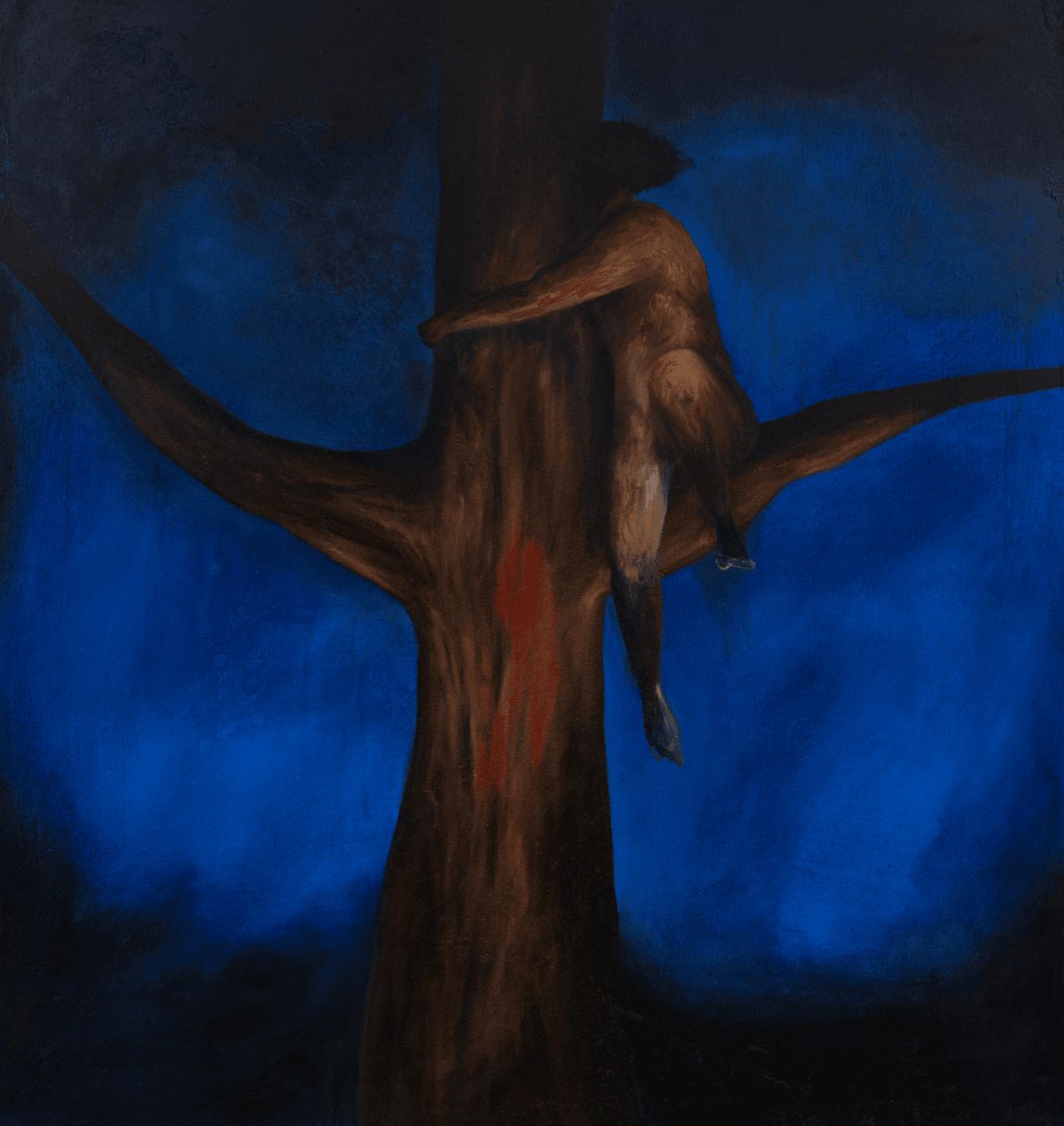
The corresponding solo exhibition’s title, The Color Blue is Warm, initially reads as contradiction, almost poetic nonsense. But Gibbs understands blue historically rather than symbolically. Blue, after all, has never been neutral. It is the bruised skin of frostbite, the divine excess of Renaissance lapis lazuli, the labor-coded indigo of denim, the endless threat of deep water. In Gibbs’ paintings, blue becomes volatile. His ceruleans radiate heat. His teals suffocate. The skies do not cool the compositions; they intensify them.
“I wanted blue to behave like fire,” Gibbs tells us.
The statement clarifies something central in the work: Gibbs paints emotion environmentally. His worlds absorb psychic conditions until landscape itself becomes sentient. Figures run, crouch, attack, mourn, cling to one another—not as narrative protagonists but as organisms responding to pressure. There are no clear villains in these paintings, only systems unraveling.
Born and raised in Brownsville, Gibbs often speaks about New York as a place of engineered isolation. Millions stacked vertically, separated by drywall, headphones, algorithms, and routine. His paintings imagine what happens when those invisible barriers fail. In many works, bodies move in packs or clusters, rediscovering forms of collective survival that feel ancient rather than futuristic. The scenes suggest that catastrophe may not create savagery so much as reveal it was always there beneath modern etiquette.
And yet the paintings are not nihilistic.
This is what distinguishes Gibbs from the wave of younger painters aestheticizing apocalypse for spectacle. His work contains devastation, but also yearning. Beneath the panic is a profound desire for reconnection—to the body, to land, to instinct, to one another. Even in his darkest compositions, there are gestures of care: a hand pulling another figure upward, bodies sheltering together against unknown weather, faces illuminated by strange blue light that reads equally as danger and transcendence.
We’ve noted the almost prehistoric quality of Gibbs’ figures. They often appear outside linear time, neither fully contemporary nor fully ancestral. One could imagine them painted onto cave walls thousands of years ago or projected onto screens decades from now. Gibbs collapses temporal distance in the same way he collapses emotional opposites. Terror becomes intimacy. Heat becomes blue. Destruction becomes rebirth.
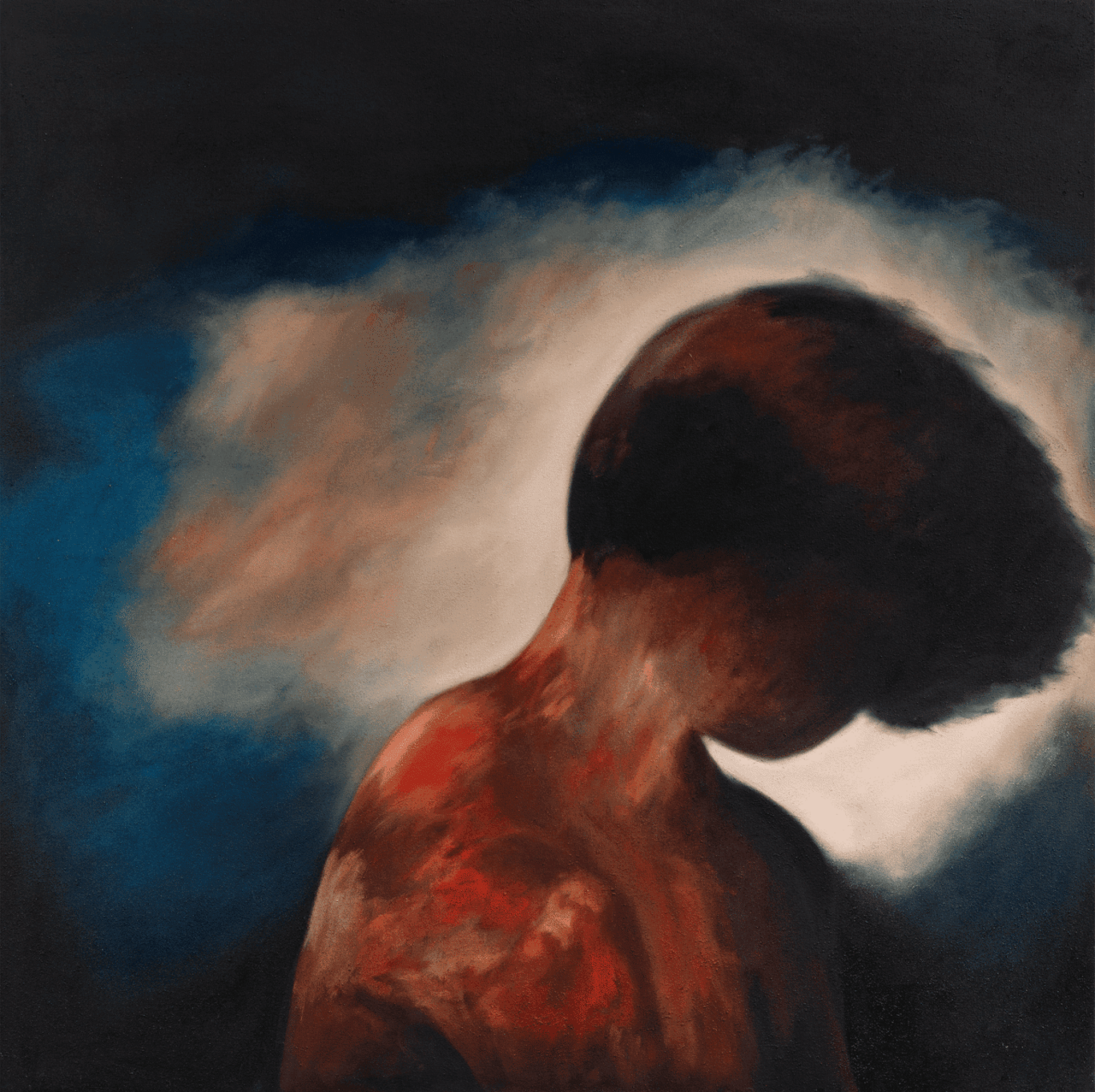
There is also something unmistakably American in his imagery. Not patriotic, but infrastructural. His landscapes carry the psychic residue of highways, overcrowded housing complexes, industrial flooding, police lights, burning electrical grids. Even when buildings disappear, urban tension remains embedded in the compositions like smoke trapped in fabric.
Perhaps that is the unsettling power of Gibbs’ work: the paintings do not depict collapse as a future event. They depict it as a present atmosphere we have simply normalized. His figures are not entering disaster. They are already living inside it.
And still, somehow, they move.
Toward each other. Toward survival. Toward whatever remains after the fire finally cools blue.